Meta Ads for agriculture are Facebook and Instagram campaigns that specifically target farmers, machinery dealers and agribusiness decision-makers within a defined radius – for lead generation, recruiting or brand awareness. They differ from other industries through smaller audiences, seasonal campaign planning and authentic content as the key success factor.
Agri-marketing on Meta works – but differently than in other industries. Those who don't understand the field season, target the wrong audience, or advertise with stock photos will burn through their budget. Not us.

Facebook has over 2.9 billion users – including many farmers, machinery dealers, barn builders, and agricultural technicians. What many don't know: the agricultural sector is disproportionately active on Facebook and Instagram. Industry groups, agricultural pages, machinery photos – this is a target group that feels at home on the platform.
On Google, only those who are actively searching look. On Meta, you reach people in their everyday lives – before they even know they want your machine, your service, or your job. This is the biggest strategic advantage of social ads.
You can define precisely: 50 km radius around Wriedel, men and women 25-55 years old, interests in agriculture and agricultural technology. No TV commercial that reaches half the country and still hits no one. Only those who are relevant.
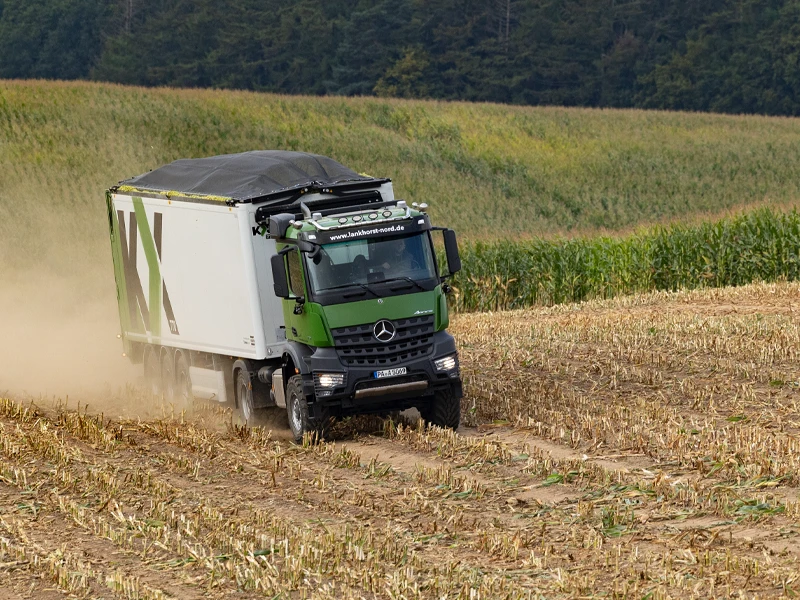
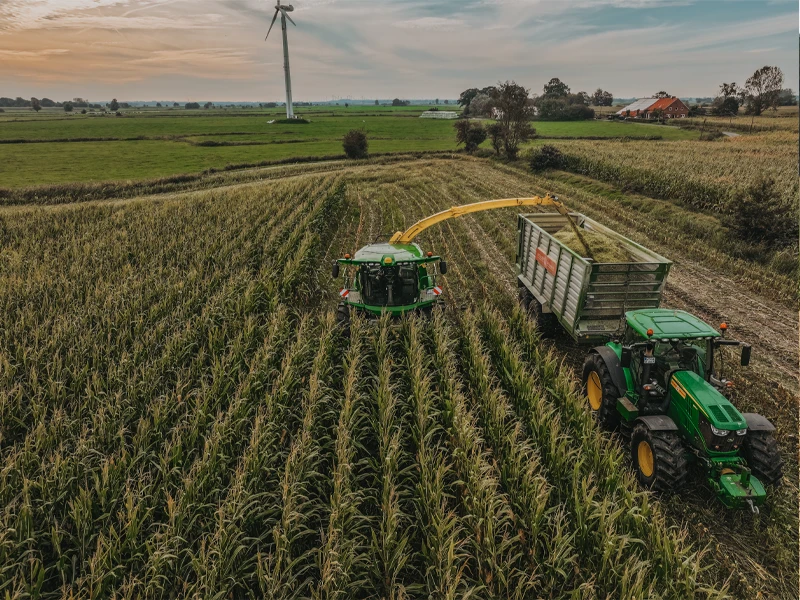
A real tractor in action, a barn builder at work, an agricultural machinery mechanic explaining what he does – this content stops the scroll. In a world full of polished ad videos, authenticity is the strongest creative signal. That's our advantage: we have the farm.
The Meta algorithm is not industry-specific – it optimizes based on signals. These four points show what that means for the agricultural sector:
01
'Farmers in Bavaria' is a small target group. The algorithm needs at least 30-50 conversions per week to optimize efficiently. With too small a budget, it doesn't learn fast enough – the campaign results remain poor, not because the advertising is bad, but because the algorithm has too little data.
02
Harvest season, sowing time, trade fair calendar (Agritechnica, EuroTier) – anyone planning Meta Ads in agriculture without a seasonal calendar will run them at the wrong time. Starting recruitment campaigns for seasonal staff in August is too late. Planning must begin 6-8 weeks in advance.
03
With small target audiences, Meta has less control over audience targeting. This means the creative must handle the pre-filtering. A video showing what real stable work looks like automatically appeals only to those who can relate to it. Poor creatives may reach the right person – but they won't convince them.
04
Since iOS 14, conversions are no longer fully tracked. Anyone without a Conversion API setup only sees 40-60% of their actual conversions in Ads Manager. This leads to incorrect budget allocation decisions. Clean tracking is therefore not an option – it's a prerequisite.
LAEND sets up a complete tracking setup for every client: Meta Pixel, Conversion API, GTM, and UTM structures. Only when that is in place does the first campaign run.

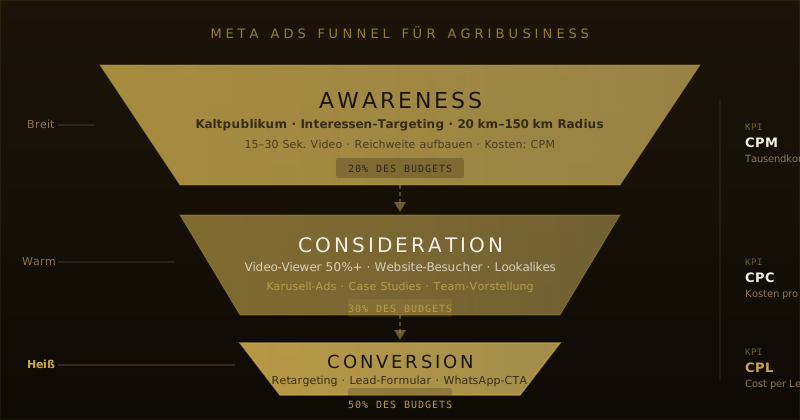
A single ad type is not enough. Those who only run conversion ads without first building trust will pay higher CPLs and get fewer qualified leads. We build complete funnels.
Stage 1
Awareness
Goal
Build awareness and establish initial contact
Format
Short video (15-30 seconds), authentic from the farm or operation
Target Audience
Broad Audience – Interests in agriculture, agricultural machinery, agritechnology within the target area
KPI
Video View Costs, Reach, Impression Share
→
Stage 2
Consideration
Goal
Deepen interest, build trust
Format
Longer video or carousel with product presentation / team presentation / case study
Target Audience
People who have watched at least 50% of the awareness video
KPI
Link Clicks, Landing Page Dwell Time, Form Views
→
Stage 3
Conversion
Goal
Lead, Application, or Inquiry
Format
Lead Form Ad or Traffic Ad to a dedicated landing page
Target Audience
Website visitors, video viewers (75%+), retargeting
KPI
CPL, application rate, landing page conversion rate
Funnel rule of thumb: budget split 20% awareness / 30% consideration / 50% conversion. In the first month, invest more in awareness to fill the funnel.
Lead generation means potential customers leave their contact details – directly on Meta or via a landing page. For agribusiness companies with products that need explaining (agricultural machinery, barn construction, precision farming), this is the most effective way to generate qualified first conversations.
01
Leads don't come from product descriptions. They come from offers: 'Free machinery consultation', 'Free barn planning check', '30-minute initial call'. The more concrete and valuable the offer, the lower the CPL.
02
For B2B agribusiness we usually recommend: a radius of 80–150 km around the location, men aged 30–60, interests in agriculture, farm machinery, livestock. Depending on the product, narrower or wider – we test that.
03
A 30–60 second video in which an employee or the managing director explains directly what the offer is and why it matters. No glossy video – authentic and clear. That's what converts best with this audience.
04
Meta lead forms have low friction – users don't leave Meta. Landing pages deliver higher-quality leads because more effort is required. We test both and optimize for quality, not just quantity.
Realistic results with LAEND: CPL €25–60 for B2B agribusiness leads. With order values of €10,000–50,000, a campaign pays for itself from the very first deal.
The biggest difference between job boards and Meta Ads in recruiting: on job boards you only find the 20% who are actively looking. With Meta Ads you reach the 80% who would consider a change – if the offer is right and comes at the right time.
Agricultural machinery mechanics, barn staff and agricultural technicians are active on Facebook and Instagram – far more than on LinkedIn or job boards. A well-made recruiting ad that authentically shows what the working day looks like stops the scroll and creates interest.
Posting a job on Indeed or StepStone only reaches candidates who are actively looking. Meta Ads also reach candidates who 'aren't really looking' – but would switch if the right offer came along. That's the most valuable group of candidates.
Audience setup (region, occupation, interests), authentic video from the business, lead form or direct WhatsApp inquiry, retargeting of page visitors, pre-qualification of applications.
Meta Ads costs consist of two items: the agency fee (for setup, management and optimization) and the media budget (which goes directly to Meta). The two should be considered separately.
€500 – €1,500 / month
Includes: campaign setup, creative briefing, ongoing optimization, monthly reporting. At LAEND, the setup (tracking, pixel, audiences) is included in the first monthly fee.
At least €1,000 / month, recommended €2,000–5,000
Below €1,000 the algorithm has too little data to optimize meaningfully. From €2,500, meaningful results and scalable campaigns become possible.
€800 – €2,500 for video/photo material
A one-off investment used for several months. LAEND produces on its own farm or on site at the client's.
CPL lead gen
€25 – €80
CPL recruiting
€15 – €50 per application
CPC landing pages
€0.50 – €2.50
Conversion rate LP
5 – 20% depending on the offer
Rule of thumb: plan €3,000 in total per month to start (agency + media budget). That gives you enough data within 30 days to make solid decisions.

01
Without the pixel, Conversion API and correct events, you don't know which campaign brought which leads. You're optimizing blind. Every campaign launched without a tracking setup wastes budget.
02
'Agricultural technicians in Lower Saxony' is a small audience. With a €200 budget, the algorithm doesn't learn. At least €1,000 media budget per month, ideally €2,000 – otherwise there's no valid data.
03
If you launch a lead generation campaign with the objective 'reach', you get reach – but no leads. Always align the objective with the result you actually want: leads, applications, website visits.
04
'Happy farmer in a wheat field' – everyone knows that image and scrolls right past it. Real content from the farm, the barn or the machine stops the scroll. Authenticity is the strongest signal for this audience.
05
Launching a recruiting campaign for harvest staff in July is too late. Launching an ad campaign for Agritechnica two weeks before the show is too late. Meta campaigns need a 2–4 week ramp-up. Always plan early.
06
Sending traffic to your homepage loses 80% of prospects. A dedicated landing page with a clear offer, one CTA and no distractions converts 3–10x better. Always build a specific page.
07
Meta Ads are not set-and-forget. The first two weeks are the algorithm's learning phase. After that the real work begins: A/B testing creatives, adjusting audiences, shifting budget to the best-performing ad sets.
01
Before the first ad runs, we set up full tracking: Meta Pixel, Conversion API, GTM, UTM parameters. We only launch once every conversion is tracked properly.
02
We define cold audiences (interest-based), warm audiences (website visitors, video viewers) and hot audiences (retargeting, lookalikes). The campaign structure follows the funnel principle.
03
We brief or produce ourselves: video hooks, carousel ads, lead forms. Our farm location lets us create authentic agricultural content without complex production logistics.
04
Weekly campaign checks, monthly reporting with CPL, ROAS, conversion rate. No agency prose – real numbers and clear recommendations.
We analyze your current situation for free – which audiences, which budget, which creatives. 30 minutes, no pitch.
Free campaign analysisYes, Meta Ads work very well in B2B agribusiness. Agricultural technicians, farm managers and buyers of barn equipment or agtech are active on Facebook and Instagram. The key is the right audience definition and a B2B-specific offer.
The algorithm's learning phase takes 1–2 weeks. The first leads or applications typically come in within the first 5–14 days. For valid, optimizable results, plan for 4–6 weeks.
Not necessarily for lead form ads – the form runs directly on Meta. For traffic campaigns to a landing page, however, a dedicated page is strongly recommended. We help you set up a landing page that converts.
In principle, anyone can. The question is whether the result is good enough. If you don't know the audiences, don't have clean tracking and have no experience with agricultural creatives, you'll usually burn more budget than an agency costs. Especially with a niche audience like agribusiness.
Meta Ads reach passive audiences – people who aren't actively searching but can be addressed. Google Ads reach active searchers – people looking for a solution right now. Ideally, you use both in combination.