


Websites for agriculture and agribusiness need to do more than traditional corporate websites: mobile-first design for smartphone-using farmers, clean tracking for performance marketing, a solid SEO structure for organic visibility, and a clear conversion architecture for leads and applications. LAEND builds all websites with Webflow.
Most websites for agricultural businesses look like they're from 2012. No tracking, no conversion optimization, no mobile design. We build websites that don't just look good – they generate leads, attract applicants, and please Google.
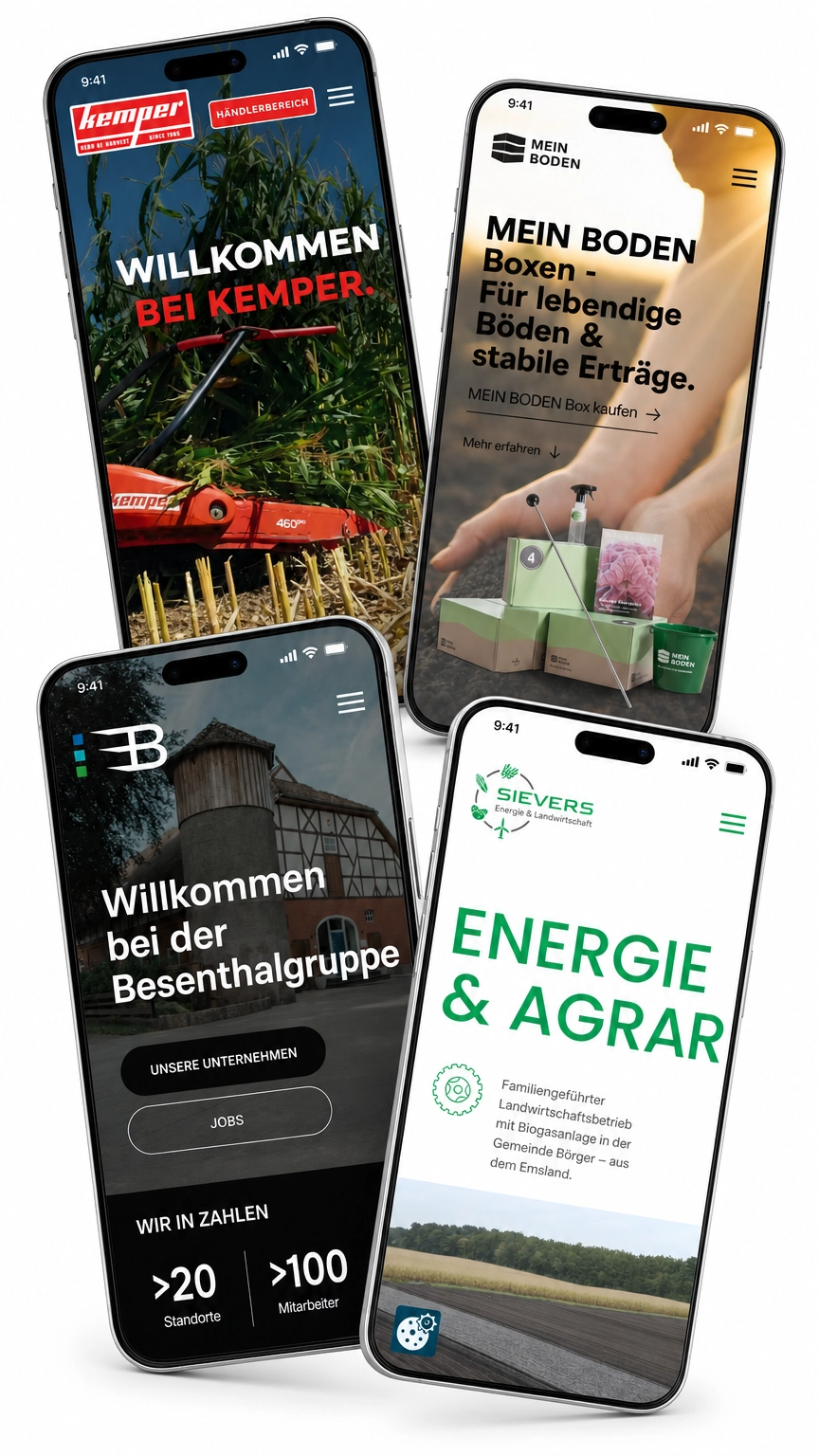
We see it with almost every new client: a website built 8 years ago, barely readable on a phone, with no tracking and a contact form that leads nowhere. That's not the exception – it's the industry standard.
Many agri websites are digital business cards – pretty, but without a job to do. No clear CTA, no lead form, no conversion optimization. Visitors come, read – and leave again without getting in touch.
Slow loading times, no SSL, not optimized for mobile – these are not minor details. Google penalizes slow, insecure websites in its rankings. And 70% of agribusiness decision-makers now browse on their smartphones.
Hire a generic web agency and you get a generic website. No industry language, no photos from the farm, no agricultural reality. Visitors from the industry notice that immediately.
Every page needs a clear goal: an inquiry, an application, a purchase. Navigation, CTAs and page structure guide the visitor to that goal – not into a dead end.
More than 65% of website visits in agribusiness come from smartphones. Responsive design isn't optional – it's mandatory.
Every second of loading time costs 7% in conversion rate. Google Core Web Vitals are a direct ranking factor. Optimized images, clean code, no plugin overload.
Google Analytics, Meta Pixel, conversion events – everything has to be connected properly. If you don't track, you can't optimize.
Title tags, meta descriptions, H1 structure, internal linking, XML sitemap – the foundation for organic visibility is laid while building the website, not afterwards.
Real photos from the farm, real employees, real machines. Stock photos of happy farmers in wheat fields convince no one in this audience.
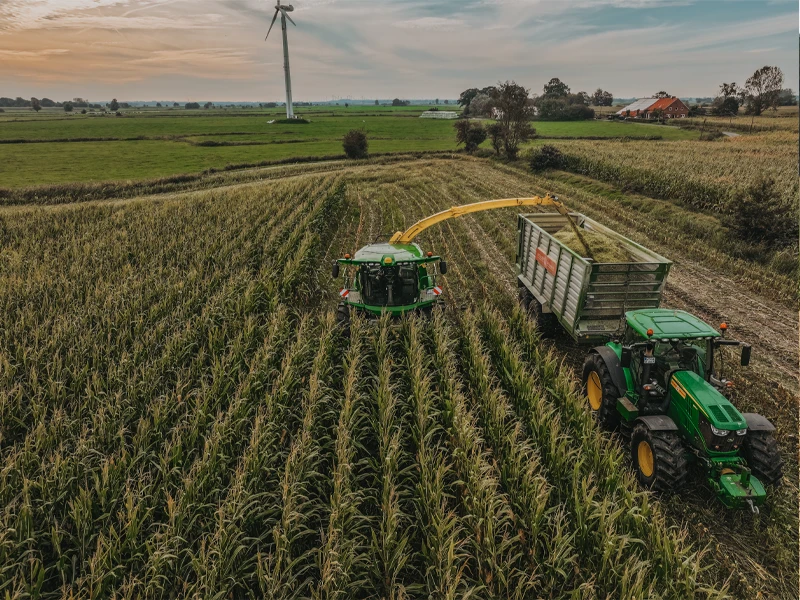
LAEND is an official Webflow Certified Partner and builds every website with Webflow. That's no coincidence – it's the result of dozens of projects in the agricultural industry. Here are the four reasons:
WordPress websites need 20–40 plugins for basic functions. Every plugin is a security risk and a maintenance burden. Webflow has all of that built in natively.
Webflow websites demonstrably load faster than WordPress and are far less vulnerable to hacking. No hosting stress, no update marathon.
You can change texts, images and content yourself – without having to call a developer. The Webflow Editor is as easy as a Word document.
Webflow enables pixel-perfect design without code compromises. And it shows: LAEND websites stand out in the agricultural industry right away.
WordPress: plugin-dependent | security risks | regular updates required | slower | cheaper to start. — Webflow (LAEND): everything native | very secure | low maintenance | faster | higher quality, better long-term investment.

Theory is one thing – results are another. Here are three real projects that show how LAEND builds websites for agribusiness companies.
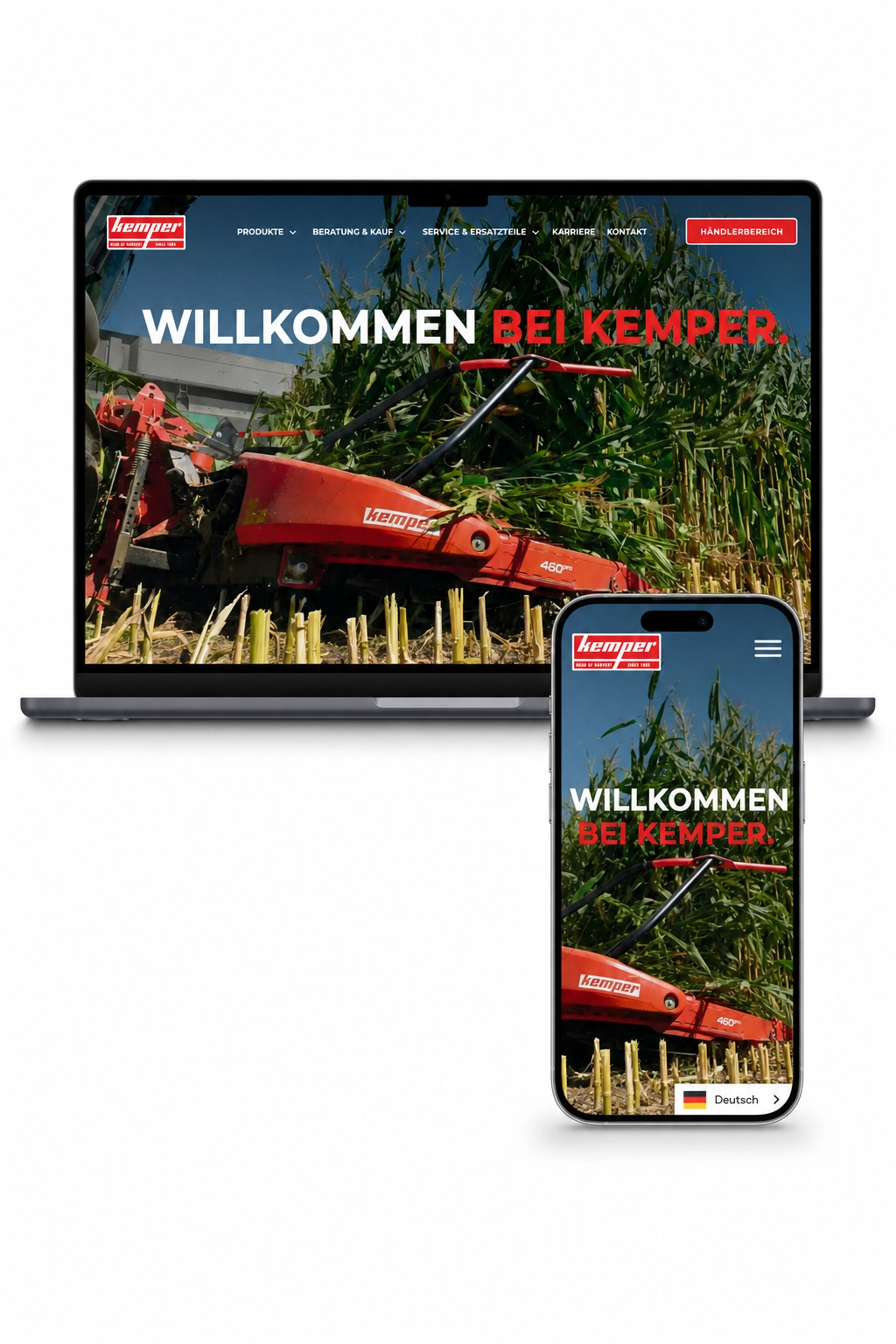
Agricultural machinery / mechanical engineering – website relaunch for one of the leading agricultural machinery manufacturers. Focus on clear product presentation, lead generation and a modern conversion architecture. kemper-stadtlohn.de

Agribusiness / group of companies – complete website build with Webflow for the Besenthal group. Clear structure, mobile-optimized, professional presentation of the business units. besenthal-gruppe.de
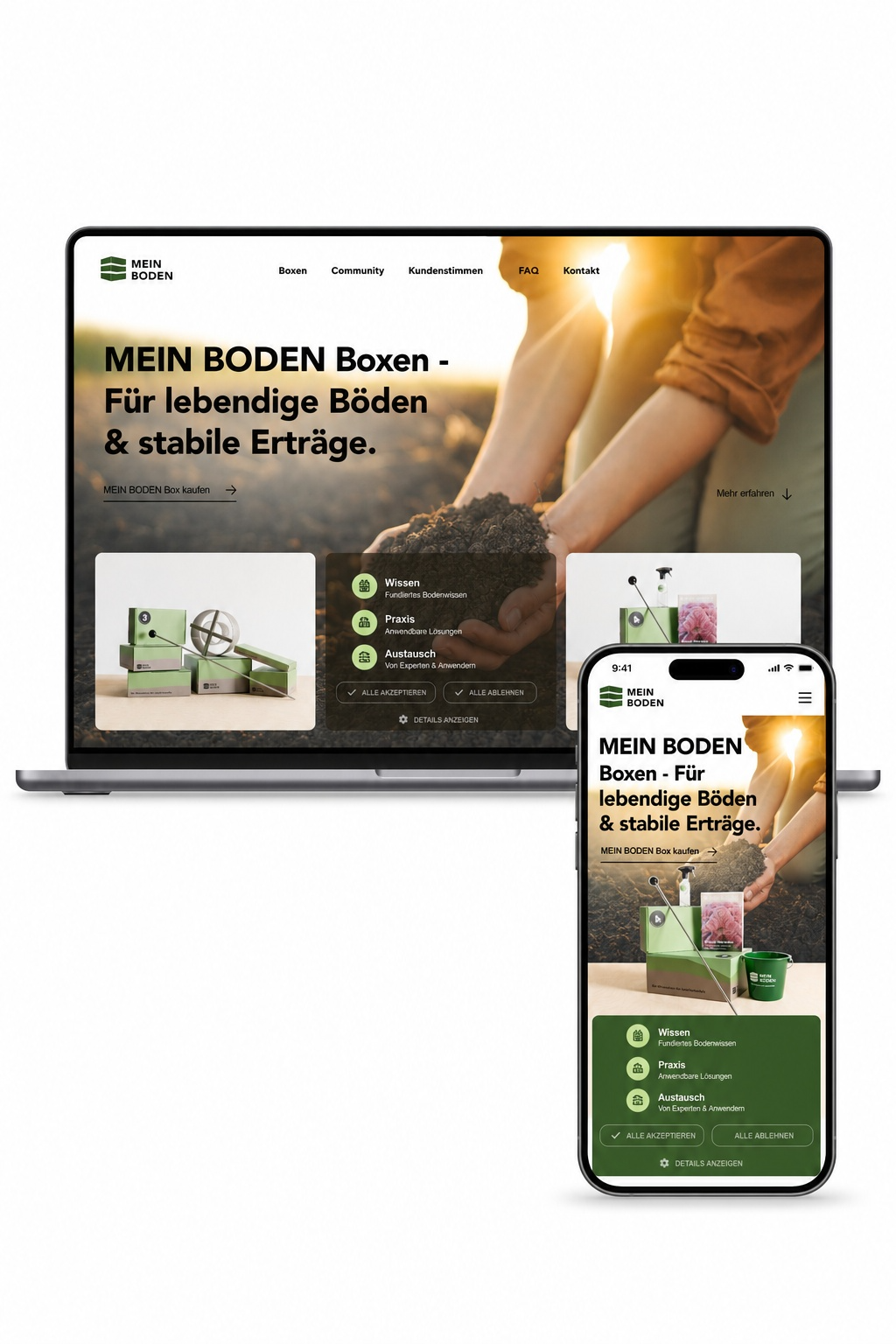
Agtech / soil analysis – website for MeinBoden, the Pauly Group's digital platform. Modern presentation, clear user guidance and conversion-optimized design. mein-boden.com
Website costs are individual – but not unpredictable. These three package tiers give you a realistic orientation:
5–8 pages, clean Webflow design, contact form, tracking setup, SEO foundation, mobile-optimized. Suitable for small farms, farm shops or individual projects.
10–20 pages, multi-page landing pages, CRM integration, blog system, full tracking, extended SEO structure. For mid-sized agribusiness companies that want to actively generate leads.
Large-scale projects: e-commerce, dealer portal, product catalog, multilingual, API integrations. For agricultural machinery dealers or larger agribusiness structures.
Rule of thumb: A good agribusiness website isn't an expense – it's the foundation of every other marketing activity. A poorly converting website makes every ad budget inefficient.
“Welcome to our website” is not a call to action. Every page needs a clear prompt: “Request a consultation”, “Apply via WhatsApp”, “Request a product”. Without a CTA, 90% of visitors leave the page without getting in touch.
Generic agricultural stock photos damage trust. Visitors from the industry can tell immediately whether images are real. Real photos of the farm, the team and the work are a must.
More than 65% of website visits now come from smartphones. A website that looks good on desktop but is barely readable on mobile loses more than half of its visitors right away.
Without Google Analytics and Meta Pixel you don't know who visits your website, where the traffic comes from or which pages convert. Tracking has to be set up while building the website – not as an afterthought.
A €500 website from a friend of a friend is rarely an investment. In practice: no SEO setup, no tracking, no CTA, hard to maintain. Fixing it later often costs more than doing it right from the start.

We get to know your business, your target audience and your goals. The result is a clear website briefing: structure, content, features, timeline.
We build a first prototype in Webflow – not a static PDF design, but a real clickable model. You give feedback, we iterate.
Copy, images, video integration, tracking setup. We produce content on your farm or site, or brief you on what you need to provide.
Go-live, SEO check, tracking verification. And: afterwards you can maintain the content yourself – we show you how the Webflow Editor works.
In a free initial call, we look together at what your website needs to deliver and what it will cost. No pitch, no one-size-fits-all packages.
Yes, of course. We build the new website in parallel and then migrate – without any downtime for your existing site.
A standard website with 5–10 pages takes 4–6 weeks from briefing to launch. Larger projects with e-commerce or special features take 8–12 weeks.
Yes – that's one of the biggest advantages of Webflow. The Editor works like a simple CMS. We train you after launch.
Yes. Webflow has a native e-commerce solution. For larger shop requirements we also integrate Shopify or WooCommerce.
Absolutely. Many of our clients start with a solid foundation (€3,000–5,000) and then expand step by step. Webflow is ideal for that – modular structure with no technical debt.


